

Preventive and interceptive orthodontics aims to remove the etiological factors of dental malocclusions to restore normal growth and development.
What are the goals of preventive orthodontics?
Removing bad habits.
Achieving proper nasal breathing.
Correct swallowing and correct tongue posture.
Competence of lips at rest.
Guide to tooth eruption.
Promoting correct bone development.
Improving the quality of life of the young patient.
Most malocclusions found in the growing patient have a multifactorial etiology, with a decisive contribution from environmental factors and, among them, respiratory disorders.
Healthy Start® and Occlus-o-Guide® devices work by guiding tooth eruption, rebalancing jaw growth and intercepting bad habits at an early age to prevent oro-functional and general disorders that can cause or derive from dental problems. malocclusion.
The purpose of this protocol is to provide useful information in the diagnosis, treatment planning and clinical use of the devices.
Tips for effective use of Healthy Start® and Occluso-Guide® devices
Before starting treatment
With the first visit, the collection of useful elements begins to formulate a correct diagnosis and create an appropriate treatment plan.
The study elements are:
1. Anamnesis and preparation of the medical record
Of particular importance is the examination of oral functions and the evaluation of any vicious habits. The questionnaire for children's sleep-disordered breathing (prepared by Orthotain®) can be completed directly by parents; provides a comprehensive overview of symptoms associated with sleep-disordered breathing and can be used to monitor improvements during treatment;
2. Photographs (intraoral and extraoral);
3. Fingerprints / scanning for study models;
4. Orthopantomography (obligatory examination before the start of therapy; allows the evaluation of any eruption problems and especially the risk of canine inclusion);
5. Teleradiography (required in cases where the presence of sagittal or vertical skeletal problems must be assessed. It allows the assessment of whether the growth pattern is normo, hypo- or hyper-divergent). Teleradiography can be used, where indicated, to stage skeletal maturation by evaluating the cervical vertebrae.
Myofunctional exercises to be performed during the day
The Healty Start® and Occlus-o-Guide® devices are a valid aid in the elimination of vicious habits and functional re-education.
Exercises for re-educating infant swallowing and lingual posture with Habit Corrector®, Class III Corrector® and Max A®
When lingual reeducation is required, it is recommended to perform exercises with relaxed lips for at least 15-30 minutes, asking the patient to focus primarily on tongue movements.
The child places the tongue on the lingual plane, touches the front marks with the tip and the lateral marks with the edges.
In this way, he practices finding a high position and avoiding abnormal interposition.
Prescribed chewing exercise with Occlus-o-Guide®
In general, it is necessary to use about 2-3 hours with intervals and discontinuous use in 30-minute periods. During these periods, the child will have to perform the chewing exercise, which is performed spontaneously during the swallowing phase. The child will have to wear the correct device with the teeth inserted into the niches, clench the teeth and release, several times during the 30 minutes, but without tiring. In this way, the muscle force is transformed into orthodontic force applied to the teeth by virtue of the elasticity of the niches.
Retraining exercises for correct nasal breathing (can be done with any device)
In oral respiratory patients, to stimulate correct nasal breathing, exercises can be prescribed that must be performed in a vertical position while keeping the device in the mouth:
"raging bull", consists of inhaling deeply through the nose and then exhaling slowly;
"nose nose": close one nostril by inhaling with the free one, then move your finger to close the other nostril and exhale with the free one.
Clinical advice for improving patient engagement
Healty Start® and Occlus-o-Guide® devices can be used at certain times of the child's day, such as when watching TV, playing on the computer/phone, writing or drawing, playing outside, or when traveling in a car.
Tips for managing contention and any phase 2
Active use should be prescribed until we have achieved our therapeutic goals; thereafter, the appliance is used only at night to retain and guide the posterior teeth in the eruption phase. It is advisable to use Occlus-o-Guide® appliances at night until the eruption of the permanent teeth is complete.
In the permanent dentition, therapy can be supplemented with N-series appliances. Therapy with Healty Start® appliances and / or Occlus-o-Guide® appliances can also be supplemented by a short phase of fixed orthodontics or aligners.
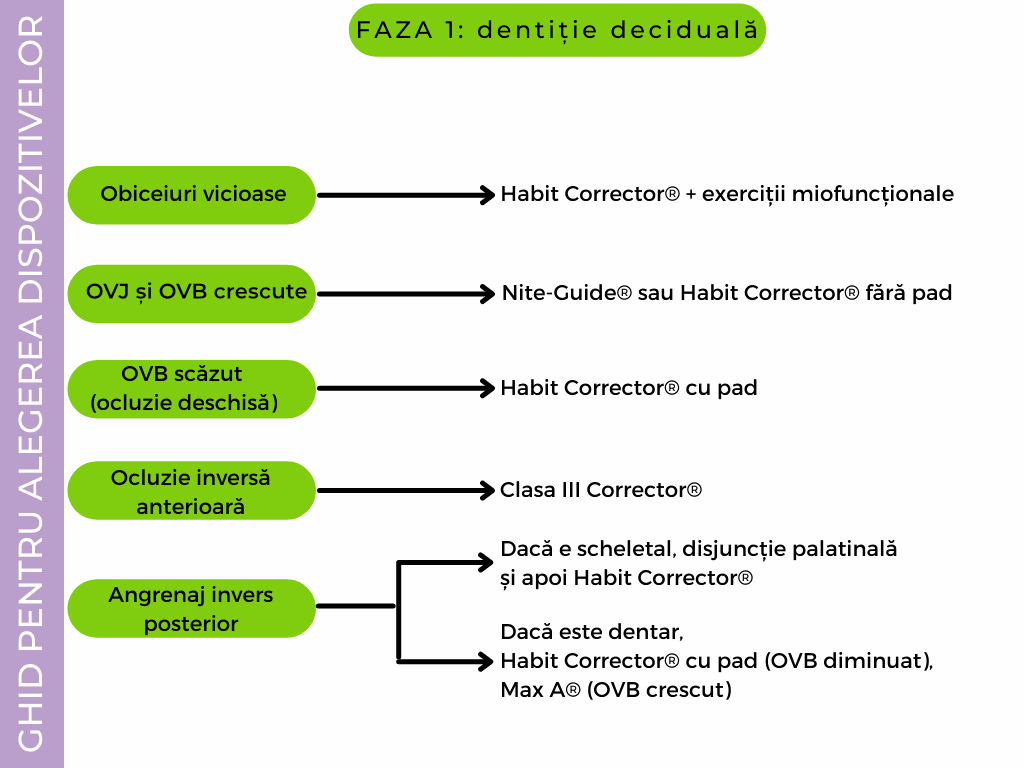
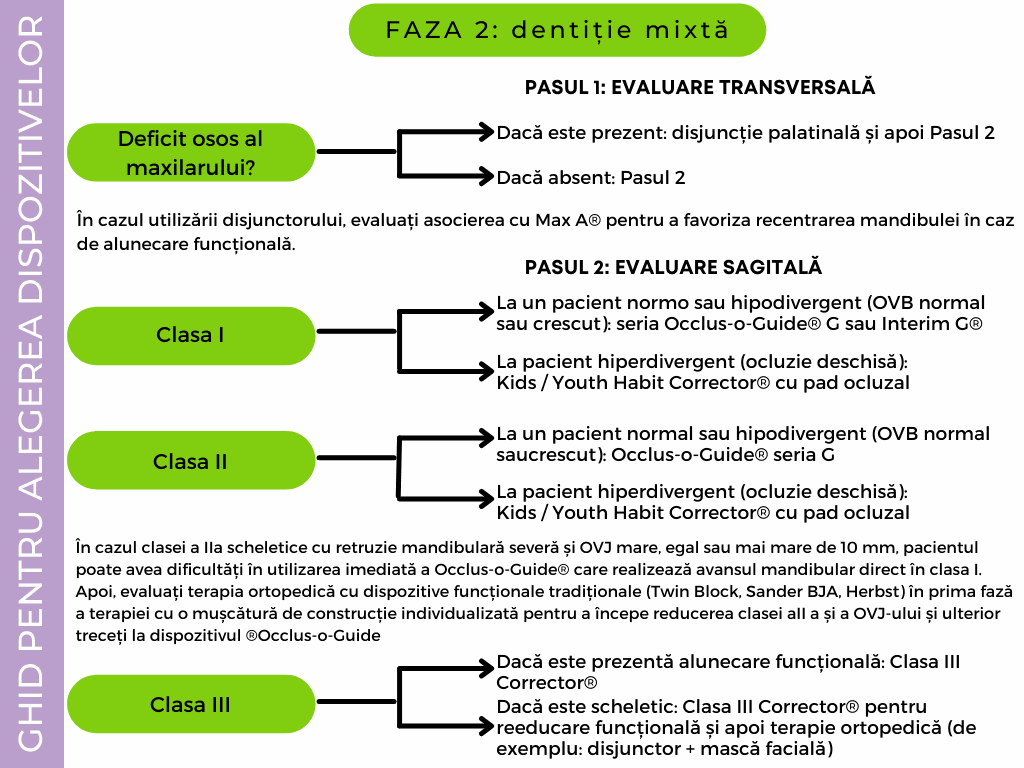
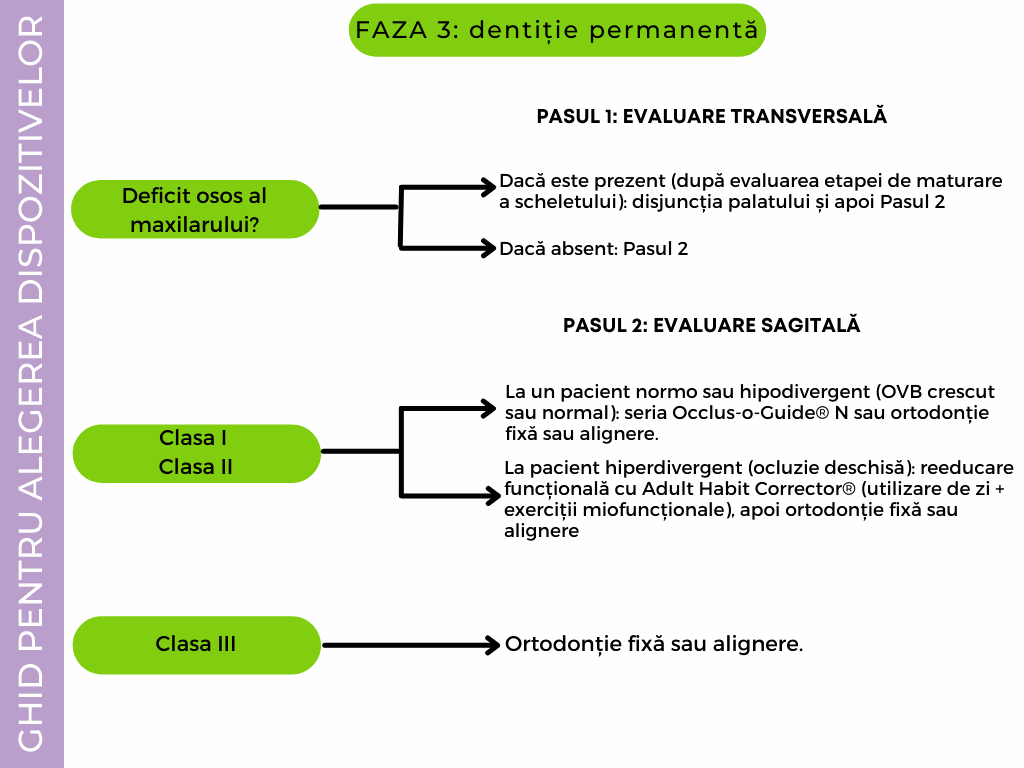
Choosing the right device and size
Nite-Guide®
The choice is made using a special ruler with which the distance between the mesial surfaces of the milk canines is measured, thus including in measure any physiological diastema of the milk dentition.
Habit Corrector®
The Habit Corrector® has no niches for the teeth, so it is available in three sizes: smaller for baby teeth and larger for mixed or permanent teeth. The chosen size must be checked on the plaster model without removing the device from the plastic box in which it is supplied. In adult patients it can be used as a myofunctional reeducator to perform exercises during the day, but nighttime use is not recommended if the largest size device (Adults Habit Corrector®) does not make posterior contact with all molars. Can be chosen with or without occlusal forests; with or without anterior extraoral handle. Occlusal pads are chosen according to the patient's divergence: in a hyperdivergent patient, where we want to control or prevent the eruption of posterior teeth, we will choose occlusal pads. If we do not need this, we can choose Habit Corrector® without pads.
The extraoral handle can have a dual function: in the young child it can more closely simulate the design of a pacifier and therefore have a substitute effect for the loss of vice; in addition, the reliefs on the tongue can represent a landmark sought by the child's lips. By practicing touching the tongue with the lips, the child performs a myofunctional exercise aimed at stretching the lips and achieving adequate lip competence.
Class III® and Max A®
They have two sizes, smaller for the milk dentition and larger for the mixed dentition. The chosen size must be checked on the plaster model without removing the device from the plastic box in which it is supplied.
Occlus-o-Guide® and Interim G®
The devices are available in 13 sizes; each half measure varies by 1.5 mm for the upper arch.
It is useful to have a stock of the most commonly used measures, which generally range from 4 to 6. The choice should be made with the appropriate ruler by measuring the distance between the distal surface of the two upper and lower permanent lateral incisors. Generally, the size chosen is that of the upper arch. In the absence of lateral incisors, the measurement can be taken on the mesial surface of the milk canines.
The measurement can be done on the cast model or directly intraoral, to be sure you have chosen the correct size you must check that when positioning the arch, all the incisors enter their respective niches, otherwise half a size larger is generally chosen . This test can be performed without removing the device from its plastic packaging.
How to choose the device in the case of diastemas or crowded teeth.
In the presence of diastemas caused by the inclination of the incisors, a device with a smaller size than the one detected is recommended.
Instead, in case of crowding we will choose a device with a larger size. Sometimes, in the case of crowding of the lower incisors, it can happen that the upper dimension is larger than the lower one: in this case, the dimension measured on the upper arch should always be used.
Otherwise, or when the dimension measured on the upper arch is less than that detected on the lower arch, we are probably dealing with a case where a preliminary disjunction of the upper arch or a preliminary alignment of the upper incisors will be necessary before resuming measurement.
Tips for using functional appliances